- calendar_today August 7, 2025
Shipping Woes Mount for Games Stuck Between Factories and Ports
The board game industry is one of invention, community, and slim profit margins. This week, it was given a financial gut punch that many fear could put their future in jeopardy. Jamey Stegmaier, creator of popular titles such as Scythe and Wingspan, took to social media in anguish over a recently announced 54 percent tariff on goods made in China and imported to the U.S.
“I sat down last night to work on a new game I’ve been brainstorming, but I found myself staring blankly at the enormity of the newly announced 54 percent tariff,” Stegmaier wrote on his blog. “It’s really hard to create something for the future when that future looks so grim.”
It was a shockingly candid (for him) look at the reality faced by a designer behind some of the most beloved games on the planet. He’s also far from the only one to raise the alarm. For small to mid-size publishers, the rule change amounts to a freight train crash and takes with it any ability to game-plan for the next year or so.
Produced in China (Even If You Don’t Know It)
America has a massive, deep-seated dependence on China when it comes to the production of board games. Germany has board game factories too, and there’s a reason why they’re considered the spiritual home of modern tabletop gaming. But for all of the components, big and small, China is the destination of choice for the full package.
That’s because China can do everything. Printed cards, custom plastic miniatures, wooden tokens, die-cut boards, specialty dice, and the list goes on.
Producing that domestically isn’t an impossibility. Stegmaier remembers being quoted $10 for a standard, empty game box by a U.S.-based manufacturer. The same $10 would cover the entire production and packaging of a game in China.
That gulf, that chasm, is why this tariff is such a gut punch. Most U.S. publishers in the space (small to mid-size ones especially) live with such slim margins that their backstop against any cost increase is simply, “Go away.” Suddenly they don’t, and there’s no time to prepare.
Trade Execs Make Dire Predictions
Meredith Placko, CEO of Steve Jackson Games (Munchkin), penned a recent post that echoed Stegmaier’s point by point. As is the case with most companies in the space, her business needs to look overseas for the same basic reason every other publisher does.
“There are several folks who have asked about this and how it impacts us,” she wrote. “Some people ask, ‘Why not manufacture in the US?’ I wish we could. I do. But the infrastructure to support full-scale boardgame production—specialty dice making, die-cutting, custom plastic and wood components—doesn’t meaningfully exist here yet. I’ve gotten quotes. I’ve talked to factories. Even when the willingness is there, the equipment, labor, and timelines simply aren’t.”
The issue, as Placko points out, isn’t just a “manufacturing issue.” It’s the lack of an entire support chain necessary to produce modern board games, and the knowledge that suddenly, a game can come out with one design set of assumptions and completely different realities.
That’s also what Rob Daviau of Restoration Games and designer of Pandemic Legacy is saying. Daviau has been active in warning the industry about the implications for several months on social media. The better part of every business meeting over that time was “an existential crisis about our industry,” he wrote in a post on Friday.
“I have been warning people for MONTHS and have heard many, many companies saying they are done releasing new products for some time,” Daviau wrote. “In a BoardGameWire interview, he went as far as to say, “I fully expect to see a great collapse in the hobby gaming market in the US if these tariffs ever take effect.”
The Consumer Cost
But this also doesn’t just impact publishers and designers. Consumers will likely start to see the cost of new games rise if the tariffs stick. Some companies will attempt to cut costs elsewhere in production in order to avoid increasing prices, but the overall quality level of games should be expected to drop.
Others may simply reduce the scope of their releases or back away from new releases altogether.
Retailers, already hurting with gamers shifting to digital storefronts, may take an even bigger hit as consumers either play from existing collections (many players have piles of still-unplayed games they refer to as their “shelves of shame”) or they simply shop online.
“In a few months, US companies will lose a lot of money and/or go out of business,” Stegmaier wrote. “And US citizens will suffer from extreme inflation.”
The Workarounds
Some publishers may route their goods through non-U.S. distributors, and European companies are less affected (sales there are roughly one-tenth of the U.S. market), but that isn’t a real solution for U.S. companies. As Stegmaier pointed out, the vast majority of his company’s sales are from U.S. customers. The revenue hit will still be painful.
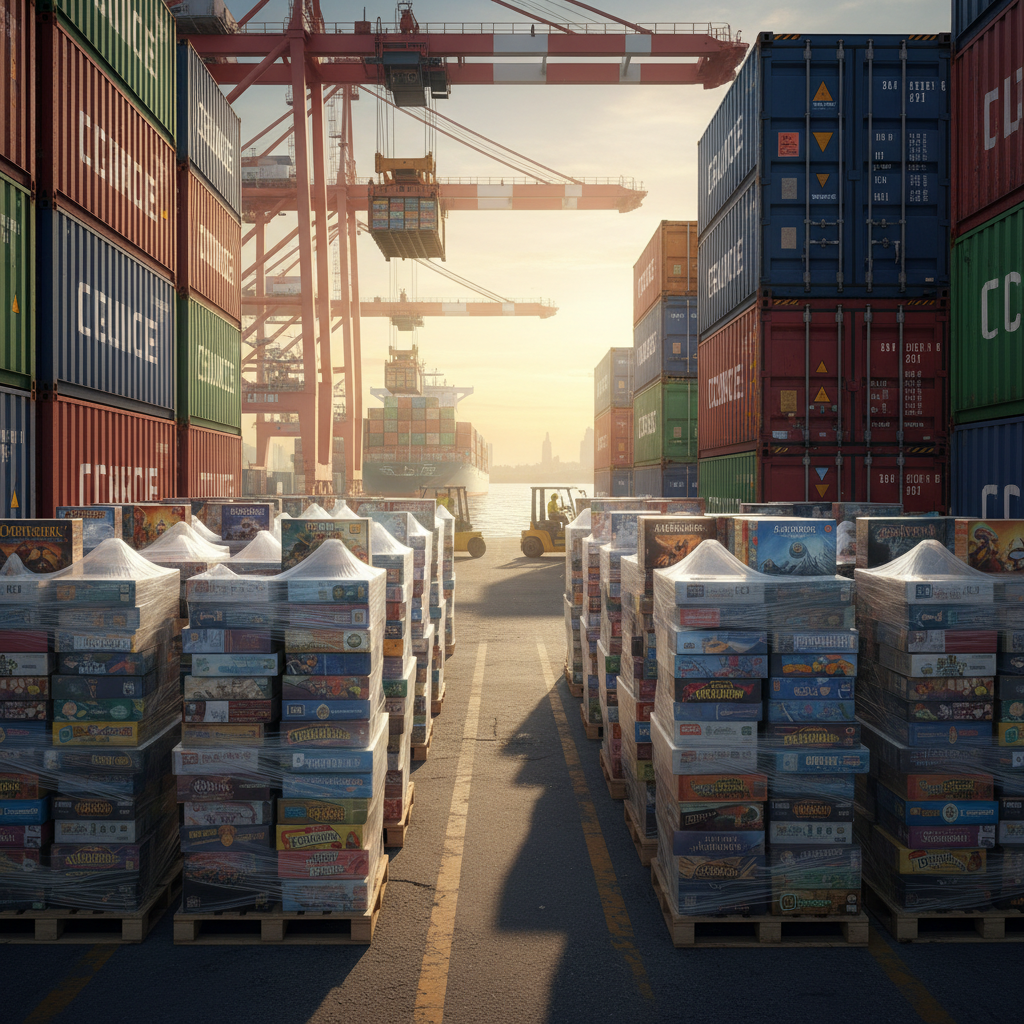
Nor is this a problem with any easy backstop. For games in development or the early stages of production, there is the possibility to rejigger a budget to account for the change. For games that have already been manufactured and are now on a ship or container from China to the U.S., no amount of problem-solving will reduce the tariff.
“The games are printed. They’ve already left the factory,” Chris Solis, who runs a California-based studio, Solis Game Studio, told The Guardian. “I have 8,000 games leaving a factory in China this week and now need to scramble to cover the import bill.”
Board Games in Distress
The GAMA (Game Manufacturers Association), which advocates for board game publishers, has already been in contact with the White House and others in Washington, as well as some of the largest companies in gaming, to discuss the effects of the tariffs.
That effort has not seen much success as of yet.
It’s hard to imagine that an industry that has worked so hard to be joyful, inventive, and inclusive will emerge from this entirely unscathed. The board game industry is currently staring down one of the biggest threats in its modern history.