- calendar_today August 10, 2025
Behind the smoke: The strange survival of the MJT
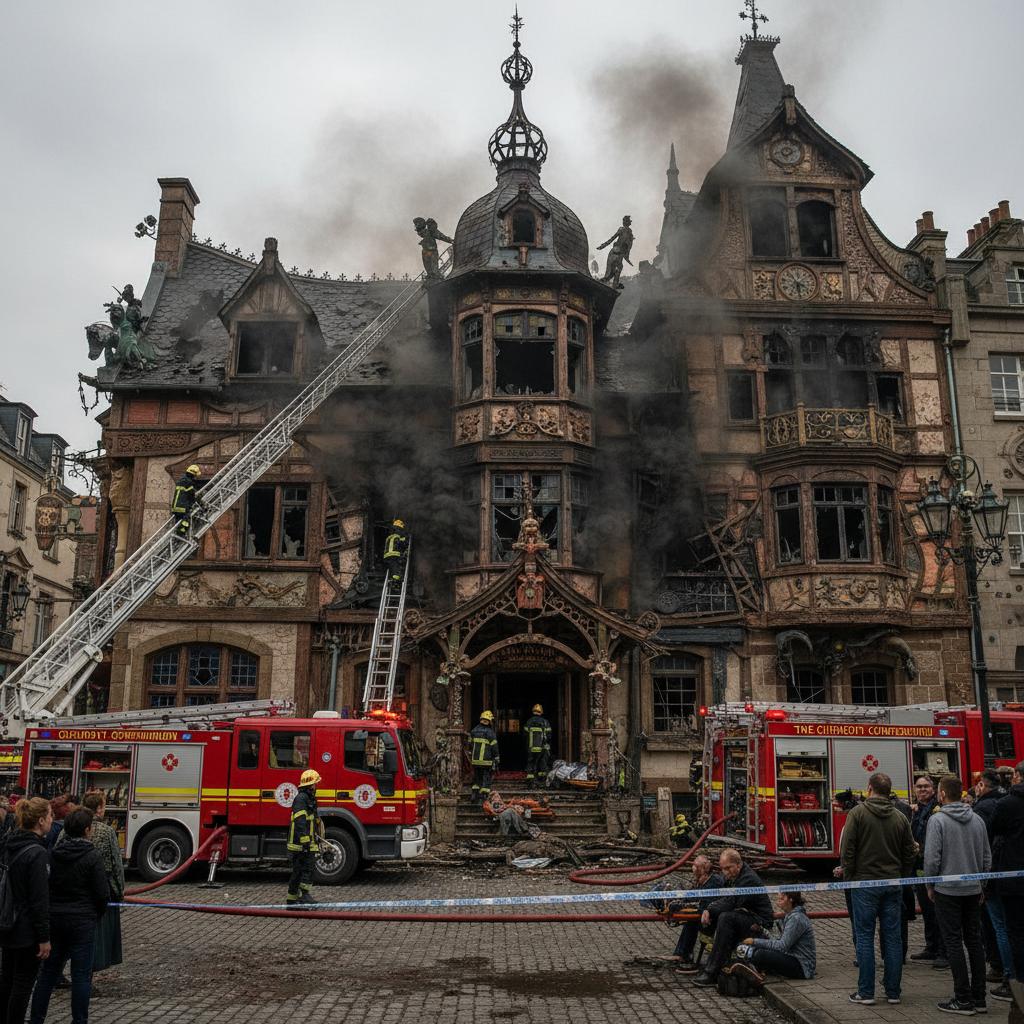
The Museum of Jurassic Technology (MJT) in Culver City, Los Angeles, has suffered major damage following a fire on the night of July 8. The MJT, one of the more eccentric attractions in Los Angeles, suffered structural damage to its gift shop and smoke damage throughout many exhibits. Revenues lost while the museum is closed are estimated at $75,000, and it is hoped to reopen sometime next month.
The museum has been a part of the Los Angeles cultural scene for some time now. Founded in 1988 by David Hildebrand Wilson and Diana Drake Wilson, the MJT has long been a destination for those who have heard of it. The institution describes itself as “dedicated to the advancement of knowledge and the public appreciation of the Lower Jurassic.” However, many of the exhibits have little to do with the Lower Jurassic, an epoch of the geologic timescale.
Inspired instead by early examples of museums, wunderkammers, or cabinets of curiosity from the Renaissance era, the MJT has built a reputation over the last 34 years for a wide variety of strange, fascinating, and occasionally questionable exhibits. The museum has an interesting relationship with the truth; some exhibits contain real historical artifacts and objects, but some blur the line between truth and fiction. One permanent exhibit documents the work of Athanasius Kircher, a real 17th-century Renaissance man and Jesuit priest with a wide range of interests and accomplishments. Another pays homage to the work of Hagop Sandaldjian, an Armenian sculptor and Holocaust survivor who created tiny sculptures so small they were made from a single human hair and placed on the end of a needle to be viewed through a microscope.
There are other exhibits as well. One feature decomposing dice was once owned by magician Ricky Jay. “The Garden of Eden on Wheels” is a photographic exhibit exploring the visual history of trailer parks in the Los Angeles area. Other objects include stereographic radiographs of flowers, microscopic mosaics made from butterfly wing scales, and a letter collection received by the Mount Wilson Observatory in Los Angeles from amateur astronomers between 1915 and 1935. The museum has also operated a Russian tea room since 2005, a space designed to replicate Tsar Nicholas II’s study in the Winter Palace in St. Petersburg, Russia.
Firefight and Aftermath
Author Lawrence Weschler wrote an extensive report on the fire, published on Substack. His 1996 book, Mr. Wilson’s Cabinet of Wonder, explored the origin of many of the exhibits at the MJT. According to Weschler, the fire was first noticed by David Wilson, who lives in a house behind the museum. Wilson first spotted the flames, which had already broken out in the back of the building, and ran back to the house for two fire extinguishers.
Once Wilson had returned to the museum with the extinguishers, the situation did not look promising. “A ferocious column of flame was rushing up the corner wall that faces the street,” Weschler writes, paraphrasing Wilson. The extinguishers were soon exhausted, but fortunately, Wilson’s daughter and son-in-law, who lived in the residence with him, arrived on the scene soon after. With a larger fire extinguisher, they were able to put out the fire before the arrival of the fire department. Wilson was told by one of the fire department employees that if they had arrived just one minute later, the whole building would have likely burned.
While the bulk of the structural damage was contained to the gift shop, smoke spread throughout the museum. Wilson described it as akin to someone “evenly pouring a thin creamy brown liquid over all the surfaces—the walls, the vitrines, the ceiling, the carpets, and eyepieces, everything.” Smoke infiltration of that scale is especially difficult and presents a challenge for an institution as focused on the presentation of its exhibits as the MJT. The staff and volunteers have worked tirelessly to clean and repair the museum, a process that Weschler described as slow and tedious.
Supporters have also been encouraged to donate to the museum’s general fund. Weschler said that the MJT is “one of the most truly sublime institutions in the country.” It is one of those rare institutions that defy easy categorization as science, art, or narrative. Weschler said that it occupies a space that is not served by other Los Angeles institutions.
The reopening date of the museum is unknown, but it is expected to reopen sometime next month. In any case, it will be a slow process. The museum’s insurance is already working on assessing the costs of the damage, but Weschler has encouraged donations to the museum’s general fund to help with revenue lost during the repairs. In any case, it will be open again. The MJT has already weathered major closures and closures. The director has described it as “eccentric satire at the farthest remove.”