- calendar_today August 28, 2025
The East-Meets-West Appeal of KPop Demon Hunters
KPop Demon Hunters is one of those rare animated films that win over audiences well beyond their expected niche. A Netflix fantasy adventure, it has been watched more than 33 million times since its June release and is still climbing the global rankings. The film, which follows a trio of K-pop idols who use music to battle demons, has already topped 93 countries’ Netflix charts and currently ranks second worldwide.
Korean pop music is the secret to its success. Fans are already creating fan art, and social media demand for a sequel is building by the day. At the same time, seven songs from the soundtrack are in the Billboard Hot 100, and the top two spots on Spotify’s US rankings are occupied by two KPop Demon Hunters tracks — a first for animated musicians, real or fictional.
To have moved so far and so fast is an achievement. Both inside and outside K-pop’s fandom, it is hard to come by. Music fans are likely to agree that its soundtrack is the key. Animation director Maggie Kang, a Korean-Canadian, was inspired by K-pop idols from her childhood, and the film, in turn, draws on a lifetime of love and knowledge from the industry. K-pop isn’t just background noise in the story. Music powers the film’s plot and propels the narrative, used to fight off evil in a plot that, although silly and far-fetched, doesn’t take itself too seriously. The result? Fans everywhere — K-pop and otherwise — are tuning in to the K-pop music they can’t seem to get out of their heads.
Risks and Rewards
Kang and her team have so far reaped the rewards. The risks were notable. K-pop already has its crossover movie, 2022’s Certified Love. Meanwhile, Netflix’s Bong Joon-ho-produced dramedy Yes, God, Yes came out last year and uses K-pop as a balm for adolescent sexual identity crises. Sung-ho Yoon, director of one of the “God, Yes” episodes and a co-founder of the Korean American Animation Project, says K-pop isn’t easy to get right: “It requires a sincere passion and knowledge of Korean pop culture”.
Production team members travelled to South Korea for research: from folk villages to Seoul street snaps and even hanbok (traditional Korean clothing). The sets also reflect this detail: from everyday dining etiquette to lesser-known cultural locations, like Seoul’s city walls, Hanuiwon medicinal clinics, public bathhouses, and Namsan Tower. It’s not a typical K-pop colour palette and cheesiness: “It goes a bit beyond a big cliché,” says Lashai Ben Salmi, a London-based community leader in Korean cultural representation. “It does feel like a film that Koreans could be excited about because it is representing us and our culture.”
Making representation feel authentic, though, is an achievement. Casting diverse and prominent figures in the Korean American scene was only one small part of this equation. “It’s in the little things,” says Eom Jihye, an American animation student of Korean descent. “Like how Koreans act: their facial expressions, how they hold their body. Korean accents.”
Another draw? Cultural authenticity. For US audiences, and many other Western countries, K-pop, K-dramas, and Korean cinema are already well mainstreamed, but KPop Demon Hunters goes further. It includes traditional Korean singing and dancing, food, unagi fish in Korean rice cakes, chopsticks, traditional table settin,g and more.
Fandom on Film
KPop Demon Hunters also nails Korean pop fan culture. The animation crew went out of its way to include fan signings and boxes (events in which fans meet celebrities to buy merchandise), the Korean words and lyrics in some scenes, and the light sticks (LED devices held by fans when cheering their idols). K-pop fans are particular about their lightsticks’ designs, and KPop Demon Hunters takes note. KPop Demon Hunters’ choreography in public concerts and dance practices, or Kalgunmu (perfectly synchronised dances and routines), is also on point. There are Korean signs, Saja BBoys holdingconcerts (crowd singing with microphones), and multi-camera shots at concerts, which even the most diehard K-pop fans would appreciate.
In other words, every time the film doubles down on the K-pop aspect, it comes across as even more authentic. References to specific K-pop cultures are wide-ranging, and other films might have focused on a single group or era. KPop Demon Hunters has room for all. “If you are a K-pop fan and are very specific to one genre, it might not hit home to you,” Golka adds. “But to casual viewers, this is it. It gives them a starting point.”
Fantasy and Folklore
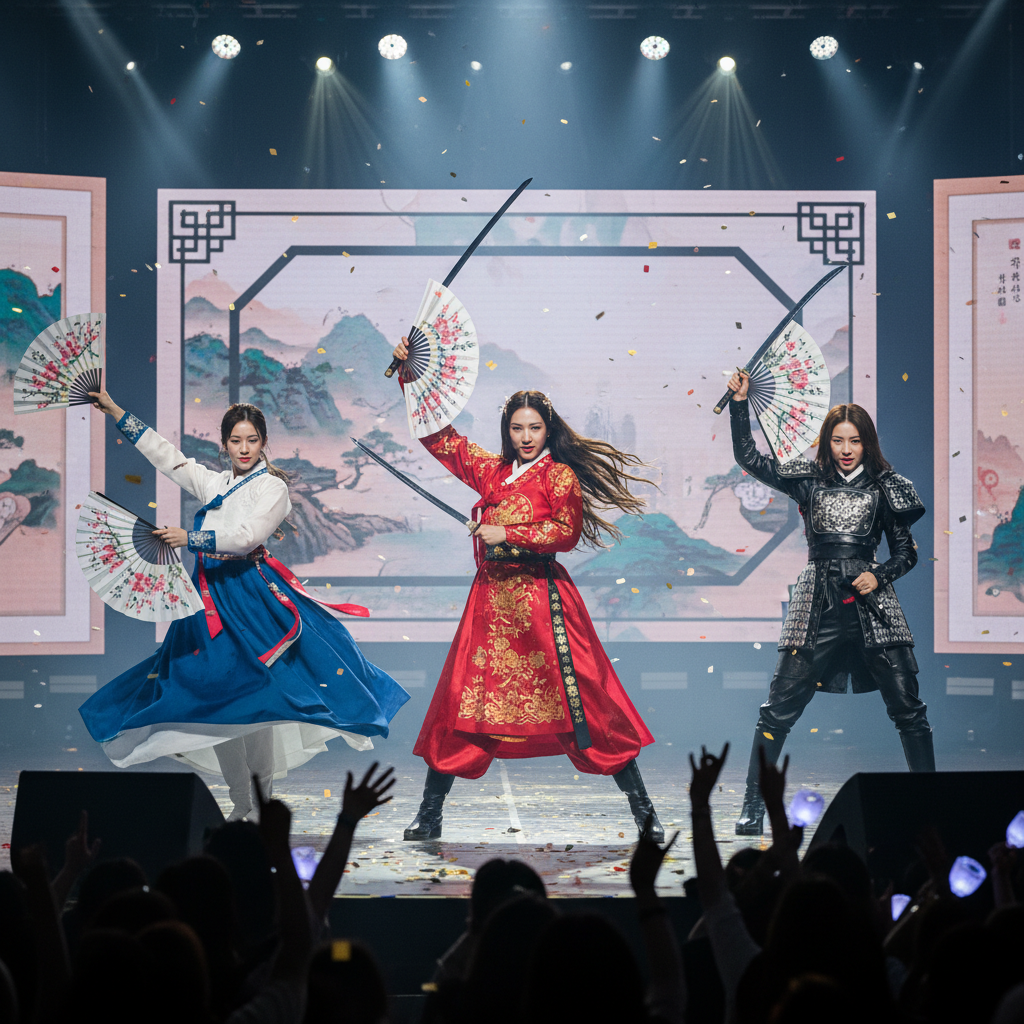
References to Korean culture and pop music aren’t just surface-level, either. The film also includes nods to Korean tradition. Huntr/x, the film’s all-female, fairy-good-doer pop group, uses shamanic-inspired swords and fans. The Saja Boys’ leader, Haunt, has long bangs, and the film’s Japanese-style demon design takes inspiration from Korean Grim Reaper imagery. Meanwhile, Dokkaebi or goblin toys appear at Saja Boys’ concerts, and Dangsan trees dot the scenery.
The detail doesn’t stop there. The KPop Demon Hunters mascot characters, Derpy the tiger and Sussy the magpie, are both based on folk-inspired mascots and related to Korean folklore tales about shamanism, warding off demons, and good fortune. The two are also K-pop references, featured on the posters and backdrops of Korean boy bands NCT Dream and Stray Kids, respectively.
For Kang, a co-director, one thing is obvious. “The three characters of Huntr/x were muses throughout my life growing up, and to be able to portray them was an absolute dream.” Self-acceptance is a coming-of-age theme that fans from any country and culture can identify with. The film has a near-universal message that appears early and stays throughout the film. It’s also in the music: “Your friends may not understand right away, but they do love you and they will figure it out”, Golka says. “I think that has resonated with people.”