- calendar_today August 15, 2025
Giger’s Species Design Explained: Sexy, Deadly, Alien
This past February, actor Michael Madsen passed away after a career in Hollywood that lasted more than four decades. Madsen, who is best known for his performances in Reservoir Dogs, Kill Bill, and Donnie Brasco, is survived by an extensive catalog of smaller roles in fan-favorite films, but few—if any—memorials have mentioned one of Madsen’s stranger roles: that of a black ops mercenary hunting a half-human, half-alien hybrid in the 1995 alien horror/thriller Species. The film, now 30 years old, was a bold, creepy, and visually interesting example of a studio-hatched creature feature at a time when both were aplenty. Let’s take a look back at Species and its place in ’90s sci-fi.
Species Blended Horror, Action, and a Dash of Sci-Fi
Directed by No Way Out and The Bounty helmer Roger Donaldson, Species is just what it sounds like: an A-list sci-fi horror film in which alien-human hybrids eventually become a problem. The film opens when U.S. government scientists receive two transmissions from space: one contains a formula for a new type of fuel; the other, specific instructions on how to splice alien DNA with human DNA. Inevitably, the scientists do as they’re told, and under the guidance of Dr. Xavier Fitch (Ben Kingsley), a half-human, half-alien hybrid is born and raised: Sil, in her early years played by Michelle Williams. The goal was to create an organism that was gentle, unaggressive, and ultimately controllable. The results are less than satisfactory.
Sil is quick to mature: in three months, she looks like a 12-year-old, but there are hints that she’s different. She suffers from nightmares, and her superiors in Dr. Fitch’s lab become convinced that she’s not as “controllable” as Fitch has promised. After Fitch decides to end the project by pumping cyanide into her holding tank, Sil escapes.
Agents on the case include Madsen’s Preston Lennox, a stocky mercenary with nothing left to lose; Dr. Laura Baker (Marg Helgenberger), a molecular biologist; Dr. Stephen Arden (Alfred Molina), an anthropologist; and Dan Smithson (Forest Whitaker), an empath who senses what Sil is feeling. As the group travels cross-country, and eventually to Los Angeles, Sil is now fully grown and played by Natasha Henstridge, begins to look for a mate. Like any other member of the animal kingdom, her goal is to reproduce—and she’s ruthless. An intellect, quick to learn, and like the mysterious forces that created her, hardwired for instinct.
Sil’s victims include a train tramp, a nightclub customer, and, after she’s discovered in Los Angeles, a young woman Fitch has picked for her as a mate. As the body count grows, Fitch’s team races to stop her—before she has offspring that can reproduce nearly as quickly.
Crafting a Monster That Would Kill
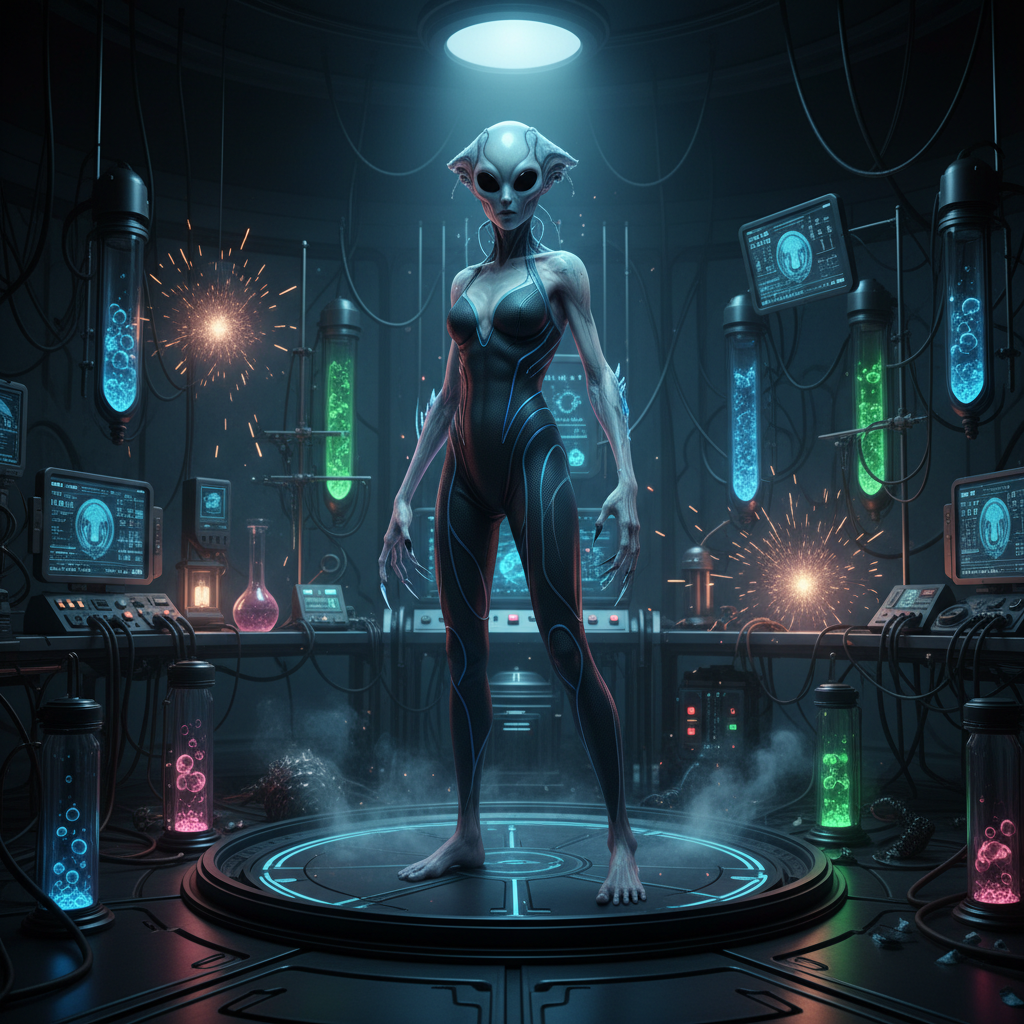
Species was memorable not just for its story and action, but for the creation of the creature that’s its titular subject. Sil was designed by surrealist artist H.R. Giger, the man who created the visual template for the xenomorph from the Alien franchise. Giger’s goal with Sil was to create something that was “an aesthetic warrior, also sensual and deadly.” Giger’s take on Sil was astonishing: in her adult form, Sil was a combination of ghostly pallor and creepy visage, described by the director as having skin that “looked like a glass body but with carbon inside.”
Giger, who had initially been brought on to create four different phases of alien evolution for Sil, was stymied by time and budgetary constraints, which meant he could only work with two versions: one as a cocoon to describe the change and a full adult female that made her last stand at the film’s climax.
Despite positive box office returns for Species and a commercial audience for Sil, Giger was less than impressed. Giger considered Species too similar to his work on the first Alien film: for example, the punching tongue and her final, gasping birth moment were seen by Giger as too close to the “chestburster” moment from Alien. Giger even flew to Los Angeles during filming to make sure Sil was killed with a bullet to the head instead of an indirect flame-thrower death, which he felt was too similar to key moments from both Alien 3 and Terminator 2.
Species: A Mixed Bag in the Laboratory
For all its ambition, Species was never a critical darling. Dialogue was stilted, and many of the characters were stereotypes or flat. Kingsley’s Xavier Fitch, for example, is an amoral “mad scientist” archetype and a bit unbelievable, while Whitaker’s psychic empath mainly exists to be in the background and state the obvious. Themes are seeded but not explored to their full potential, and the science itself isn’t advanced: bioethics, alien life, and maternal instinct all exist in the world of Species but are left as tinctures and afterthoughts. Feldman had some grander ideas: after being inspired by an Arthur C. Clarke article that floated the idea that it might be physically impossible for alien life to reach Earth (because of FTL travel), Feldman had an idea for a story in which extraterrestrial lifeforms might reach Earth by some other means, such as leaving a blueprint for organic life on Earth.
The result, eventually, was a film that combined elements of cautionary tale with a straight-up creature feature. It’s hard to imagine a creature as memorable as Sil getting as wide of release today. Species, despite its weaknesses, has a strange magnetic pull that’s best understood in the context of the films that inspired it. Feldman’s idea would eventually see life in other films, many of which were better in some ways and worse in others, like David Fincher’s Se7en or Andrew Niccol’s In Time, both of which spun similar yarns around high-concept seed ideas.
Species will never sit next to Alien or Terminator in the canon of sci-fi greats, but it did find an audience. And the reason it did—between Henstridge’s indelible, otherworldly performance, Madsen’s scarred, grizzled nature, and Giger’s brilliant monster design—speaks to Species’s time as a cult ’90s sci-fi curiosity that’s worth a revisit for both how it was made and for its creative, strange surprises.
Species turns 30 this year, and while Michael Madsen is gone, his roles—including his unforgettable turn in the mid-’90s hit—will live on. Madsen was 74 at the time of his death.