- calendar_today August 14, 2025
.
In the United States, electric vehicles are running into new doubts as sales waver and infrastructure concerns persist. The recent trend of month-to-month sales growth has been in place for more than a year; now, EV sales have started to shrink. Customers are already walking away from the Genesis and Volvo electric cars, leading both automakers to reevaluate their offerings.
Compounding the issue are political headwinds; President Biden has reduced subsidies and rescinded vehicle emissions standards, removing much of the federal incentive to purchase an EV. But as some industry analysts suggest, the biggest hurdle may not be on Capitol Hill. The largest impediment to EV adoption could be in Americans’ own garages.
Charging where you park
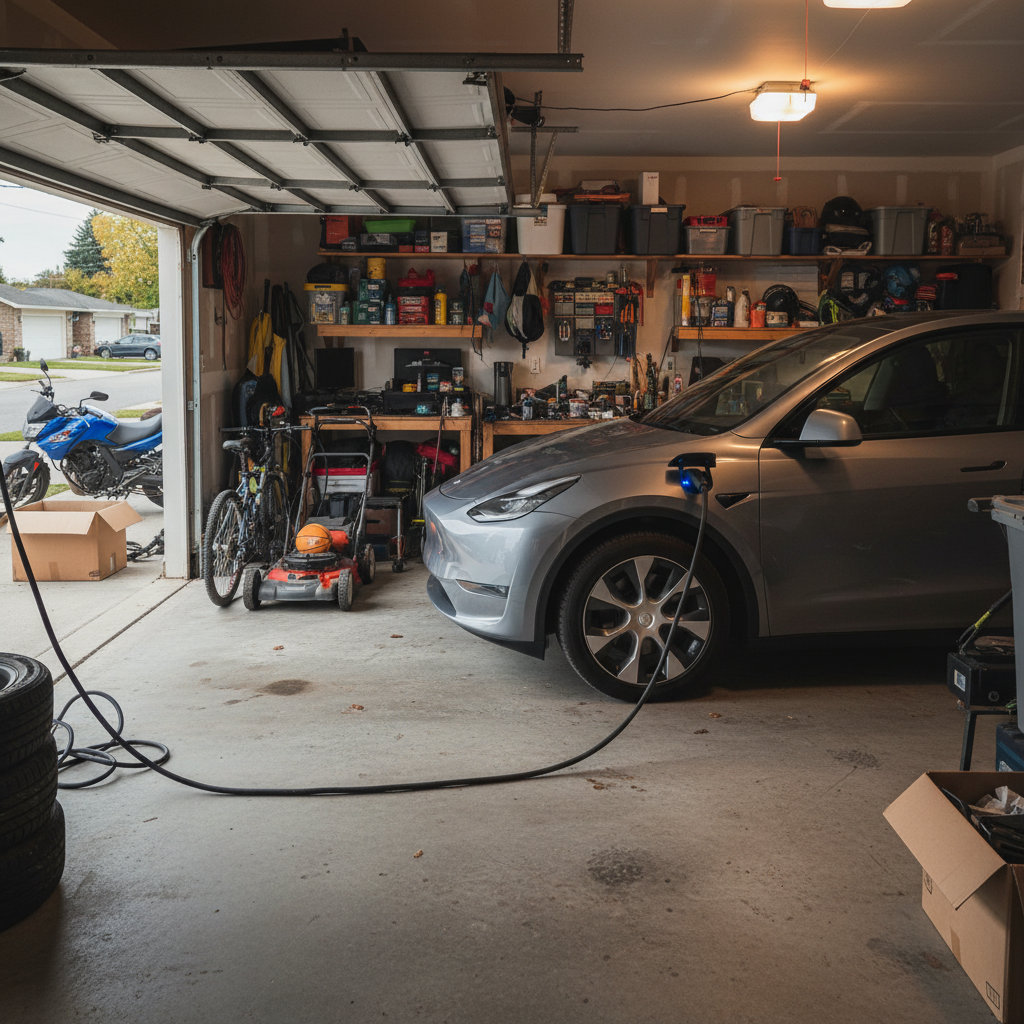
There’s a common refrain in EV surveys: chargers are the number one concern for EV buyers. A new Telemetry study from Vice President Sam Abuelsamid dives into the charging issue, and his findings implicate one source in particular: garage clutter.
Hypercharger networks and new infrastructure get most of the press. The reality is that most EV charging will continue to take place at home. An estimated 80 percent of EV charging events still use AC power, usually at a single-family residence. A recent National Renewable Energy Laboratory (NREL) study shows 42 percent of homes already have parking locations near an outlet capable of level 2 (240 volt) charging.
That percentage has the potential to grow dramatically: to 68 percent, if homeowners make room in their garage and adjust their parking behavior. “Parking behavior, namely whether homeowners use a private garage for parking or storage, will likely become a key factor in EV adoption,” Abuelsamid states. Converting garages to EV charging could increase the number of homes able to plug in from 31 million to over 50 million. Include homes where new wiring is possible, and this figure jumps to more than 72 million. These levels of EV charger-equipped homes easily eclipse even Telemetry’s most optimistic penetration projections, which put the number of EVs in use by 2035 between 33 and 57 million.
There is a key caveat here. This charging capacity isn’t the same as charging readiness. The same NREL study also points out that close to 34 million homes would need extensive and expensive electrical upgrades just to support a 240-volt level 2 charger, which typically requires at least 30 amps of power. New wiring and other improvements can cost homeowners thousands of dollars, while in some cases, panel replacement and electrical work is also needed.
That problem undercuts one of the main benefits of EVs: long-term affordability. Add the cost of charging installation to the upfront purchase price, and the lifetime ownership cost of an EV can quickly rival that of a gasoline vehicle.
Multifamily housing struggles
The situation is even more challenging for the 23 percent of Americans who reside in multi-family buildings such as apartments, condominiums, and townhomes. Few individual owners have the authority to install chargers in these situations, instead needing to petition landlords, management companies, or co-op boards. Gaining this permission can be an uphill battle, as some landlords are opposed to the installation of chargers on principle. Whether landlords are receptive or not, residents may also lack the financial means to make the upgrade themselves.
The installation costs for multifamily buildings are also higher. Shared level 2 chargers in a cooperative building, for example, might first require a full electrical panel upgrade, a project that could run into the millions. Wiring runs to far-flung parking spaces are also a headache. Where landlords have little discretion with chargers in single-family housing, residents in multifamily structures are also often ineligible for municipal or utility subsidies to help defray installation costs.
As of now, approximately one million EV drivers live in multifamily residences, but only 11 percent of these owners park near enough to a plug to charge. Some states are starting to require 20–25 percent of spaces in new developments to be EV ready, but even with those mandates in place, Telemetry estimates only between 6.7 million and 11.4 million charging capable spaces in multifamily dwellings by 2035. Even those numbers may not be sufficient to meet demand.
Gap in public charging
Home charging can only meet so much of the need. Telemetry’s modeling projects that between 11.7 million and 14.3 million EV owners who have single-family homes will still need to rely on public charging by 2035. Another 7.8 million to 8.1 million EV owners who live in multifamily residences will also require public charging.
Meeting the needs of these drivers will require 523,000 to 586,000 DC fast chargers nationwide, in addition to 1.5 million to 1.6 million level 2 chargers. Expanding this public infrastructure has its own obstacles. Utilities are already coming under pressure; big new AI data center projects are actively competing for generation and distribution capacity, making it challenging to site and roll out large charging sites.
A year after the COP27 Climate Conference in Egypt, the EV future looks less rosy than it did a few years ago. While millions of homes have the technical ability to support EV chargers, both garage clutter and electrical upgrade costs may be serious impediments to charger installation. Multifamily housing represents a major challenge, as well. Despite a highly expansion of public charging infrastructure, the demand for public chargers may outstrip the supply in the next decade.
One thing is certain: For electric vehicles in America, the future may hinge as much on homeowners’ garages as it does on federal incentives or carmaker’s strategies.