- calendar_today August 17, 2025
Google advances its artificial intelligence capabilities with the introduction of its next-generation Tensor Processing Unit (TPU), now in its seventh iteration named Ironwood. Google’s hardware strategy has taken a significant step forward with this custom chip, which meets the complex requirements of its most advanced Gemini models beyond basic upgrades. Google developed Ironwood specifically to dominate simulated reasoning tasks identified as “thinking,” and it promises to launch a transformative new phase in AI technology.
Ironwood’s Design and Purpose
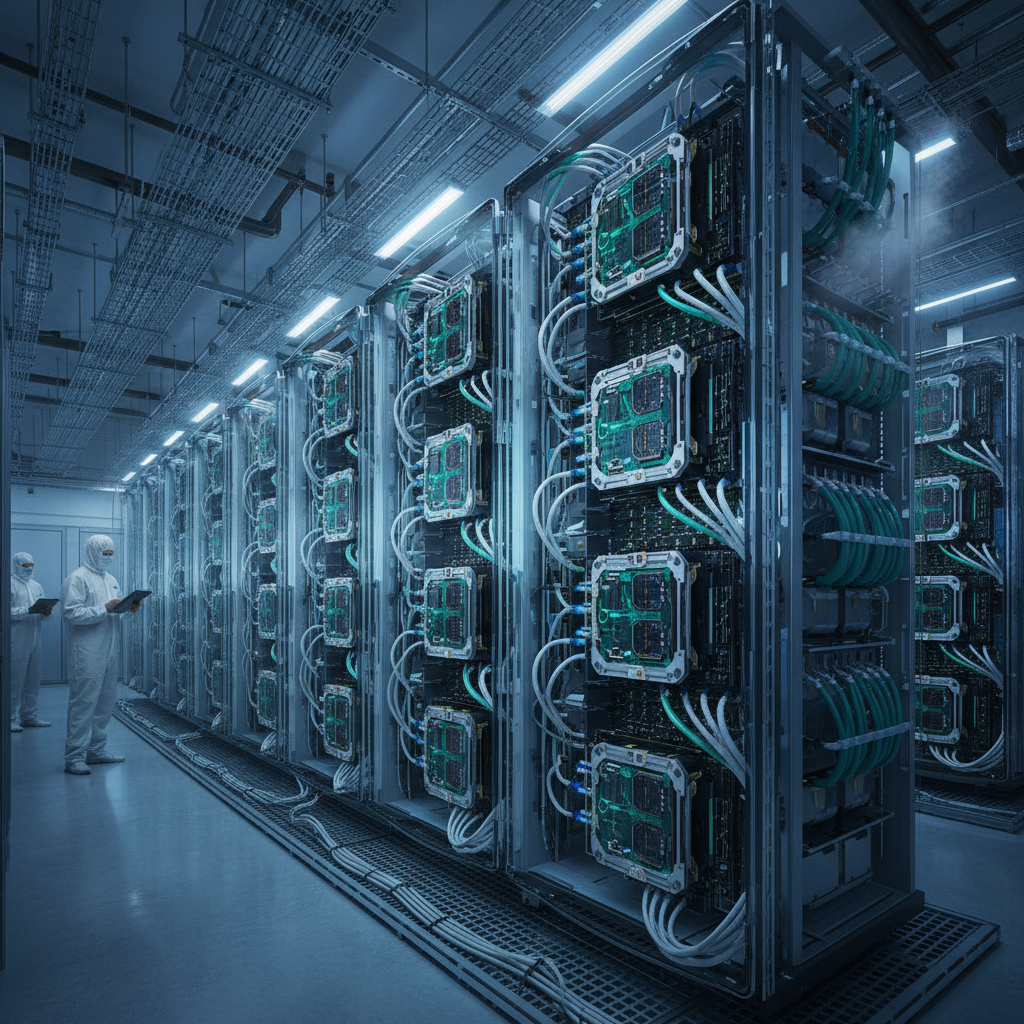
Ironwood achieves its advanced capabilities through meaningful progress in system performance and structural design. Ironwood delivers a much higher throughput performance than previous TPU models and functions in large-scale liquid-cooled clusters. The clusters consist of up to 9,216 individual chips, which are connected through a newly improved Inter-Chip Interconnect (ICI) system that enables high-speed and efficient communication between them. Google’s scalable architecture allows both its own research teams and external Google Cloud developers to utilize systems from 256-chip servers to full 9,216-chip clusters.
Google’s Vision for AI
Google predicts that Ironwood’s superior speed performance, combined with its expanded memory capacity and reduced power consumption, will create substantial changes in its AI system, which will lead to major advancements. Ironwood provides a strong computational base for advanced AI models, which should spark development breakthroughs across multiple domains such as natural language processing, machine learning, and agentic AI. The next generation of AI is expected to operate as proactive systems that autonomously collect data and make decisions based on information with minimal human input. Through its continuous advancement of AI frontiers, Ironwood stands out as a crucial enabling force in Google’s transformative technological journey.
The Driving Force Behind Ironwood
Google’s development of Ironwood demonstrates its belief in the essential connection between cutting-edge AI models and specially constructed infrastructure systems. According to Google Ironwood functions beyond its speed capabilities as a foundational element of their strategy to boost inference rates and broaden AI model context limits to achieve “agentic AI” capabilities. In the “age of inference,” Google predicts AI systems will start acting on users’ behalf as part of their new paradigm shift.
Ironwood’s Technical Specifications
The detailed specifications of Ironwood clearly demonstrate its computational capabilities. The maximum inference computing performance of a complete Ironwood pod reaches 42.5 Exaflops. The peak throughput of each Ironwood chip reaches 4,614 TFLOPs, which marks substantial progress beyond what previous TPU generations could achieve. Enhanced processing capabilities receive support from Ironwood through its significantly upgraded memory architecture. The Ironwood chip contains 192GB of high-bandwidth memory, which represents a sixfold expansion from the memory capacity of the Trillium TPU. Memory bandwidth achieved a major improvement with a new rate of 7.2 Tbps, which represents a 4.5 times increase.
Benchmarking Ironwood
Google has published benchmarks to evaluate Ironwood’s performance where FP8 precision serves as the fundamental metric. Google claims Ironwood “pods” achieve 24 times faster performance than segments from the world’s top supercomputers, but these results should be understood with cautious interpretation. Google recognizes that certain supercomputing systems lack native support for FP8 precision, which alters the benchmark comparison results. Ironwood has not been compared head-to-head with Google’s TPU v6 (Trillium) in direct performance evaluations. Google confirms Ironwood reaches double the performance per watt of Trillium, which shows increased energy efficiency. Ironwood continues the TPU v5p lineage, but Trillium builds upon TPU v5e according to a Google spokesperson. Trillium reached a maximum FP8 performance level of approximately 918 TFLOPS.