- calendar_today August 17, 2025
In a speech ostensibly meant to focus on the EU’s approval of a trade deal, former US President Donald Trump recently leveled a series of bizarre claims against wind turbines. Describing wind farms as a “con job,” the former president accused turbines of driving whales “loco,” killing birds, and even blowing down people. These sorts of comments are familiar to observers of Trump’s relationship with clean energy: he’s long had an affinity for making flamboyant attacks on wind turbines and other technologies. However, Trump is only the latest in a long line of individuals and organizations repeating misinformation and conspiracy theories about renewable energy. Far from being aberrations, such comments are common all over the world—and they point to a profound challenge to efforts to scale up clean energy.
In recent years, Trump has resorted to calling wind turbines “windmills” on a number of occasions, and the practice of renaming wind farms “windmills” has become something of a meme among the president’s opponents in the climate community. Earlier moral panics around new technologies, such as the early-20th-century fear that telephones would spread diseases like cholera, offer interesting points of comparison. On one level, both the “windmill” hoax and the telephone panic represent fears about technological change. Switching to renewables would upend entrenched energy sources and systems, and could easily be framed as an attack on traditional or rural ways of life. But the telephone conspiracy also had an anti-modernist edge: the technologies were both often described in terms of mass surveillance or manipulation. Both events, ultimately, represented broad challenges to the status quo.
Academic studies suggest that such issues run much deeper. Beliefs like the windmill health risk cannot be explained by demographic factors such as age, gender, education level, political affiliation, or level of support for other environmental issues. Rather, academic studies have shown that opposition to wind farms is better predicted by belief in conspiracy theories. A 2008 study of German residents conducted by Kevin Winter and his colleagues found that conspiracy thinking was a far more accurate predictor of opposition to wind projects than the demographic factors above. More recent polling data from the US, the U.K., and Australia has shown that conspiratorial thinking on one issue (such as climate change, vaccination, or energy security) is linked to conspiratorial thinking on others (such as wind turbine risks). In short, if someone believes in a particular conspiracy theory, there’s a strong chance they’ll accept other conspiracy theories.
For the people who hold these beliefs, pointing out the facts—that wind farms don’t poison groundwater or cause mass blackouts—doesn’t help much. Opposition to windmills is more an issue of worldview than of fact. A 2022 survey in the U.K. found that public acceptance of wind energy could only be improved with a successful climate change adaptation response—essentially, that the public would be more willing to embrace clean energy sources once the negative effects of climate change were seen to be being mitigated. (For related reasons, public acceptance of solar farms and other clean energy sources may also prove challenging). As Winter and his colleagues put it, opposition to wind farms is “rooted in people’s worldviews.”
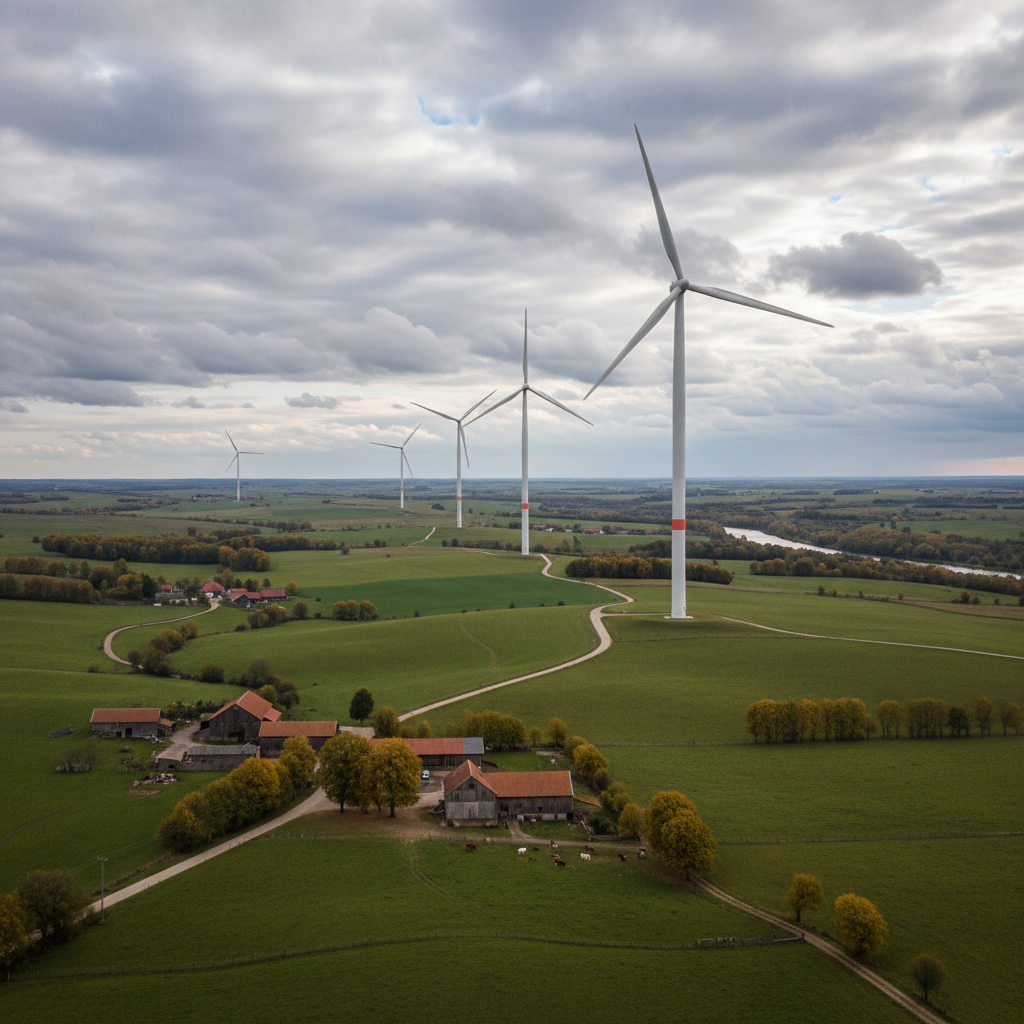
Wind farms in particular seem to be symbolic representations of a larger, broader set of cultural changes, whether positive or negative. For supporters, turbines are the future; for opponents, they represent government overreach or the world moving too quickly. Turbines can be big and imposing, in a way that oil fields and pipelines often aren’t. This has led to concerns about turbines’ visual impact on rural areas, as well as conspiracy theories like the “wind turbine syndrome.”
To many people, the fossil fuel era is not just an era of technological development, but a time of economic growth and social development. The idea of burning all that hydrocarbons for no purpose can therefore seem like a waste, or an insult. Geographer and political theorist Greg Scruggs has even written about some segments of this resistance as “anti-reflexivity”: a refusal to dwell on or reflect on the negative consequences of one’s actions. (The word “reflexivity” does not, in this context, mean “thinking back on past events”—it has a much more technical definition in the philosophy of social science). In this light, Trump’s rhetoric around coal, oil, and gas—which often veers into nostalgia for the fossil fuel era—can be understood as part of that same worldview.
Culture war politics and identity also play a role here. Some climate denialist communities online, such as parts of the so-called “manosphere,” have gendered criticism of action on climate change, or dismissed it as weak or effeminate. In the context of some parts of the manosphere, the clean energy transition is also a disorienting cultural shift in a world where certain groups once felt they had firm power or control. Many white heterosexual men of baby boomer age, for example, may be especially resistant to the transition. For them, opposition to the clean energy transition is both an issue of technology and an issue of culture and identity.
In this context, Trump’s personal war on “windmills” takes on new meaning. For many of the president’s supporters, the energy transition is less an opportunity than a loss of way of life. In this light, Trump’s colorful allusions to birds, whales, and cancer patients’ bodies, even when spectacularly false, are just as much an emotional appeal as an informational one. Trump’s antics with wind turbines are mere theater; the core of the problem is a culture war over the future of the energy system.