- calendar_today August 12, 2025
.
Washington and New Delhi once boasted one of the most productive and vibrant strategic partnerships among major powers in the post–Cold War era. The relationship, now in shambles, has hit a new low as India reorients toward Moscow and Beijing.
“We’re in a situation in the U.S.-India relationship where the premises and assumptions of the last 25 years — that everybody worked very hard to build, including the president in his first term — have just come completely unraveled. The trust is gone,” said Evan Feigenbaum, a South Asia expert at the Carnegie Endowment for International Peace.
India has been caught in the crosshairs of tariffs for months, after President Donald Trump slapped steep duties on Indian imports in retaliation for New Delhi’s decision to continue buying Russian crude oil despite Moscow’s invasion of Ukraine. Tariffs are currently set at 25 percent and will rise to 50 percent on August 27. The move was supposed to pressure India to buy less Russian oil. Instead, it has done the opposite, pulling New Delhi even closer to Russia and, to a lesser extent, China.
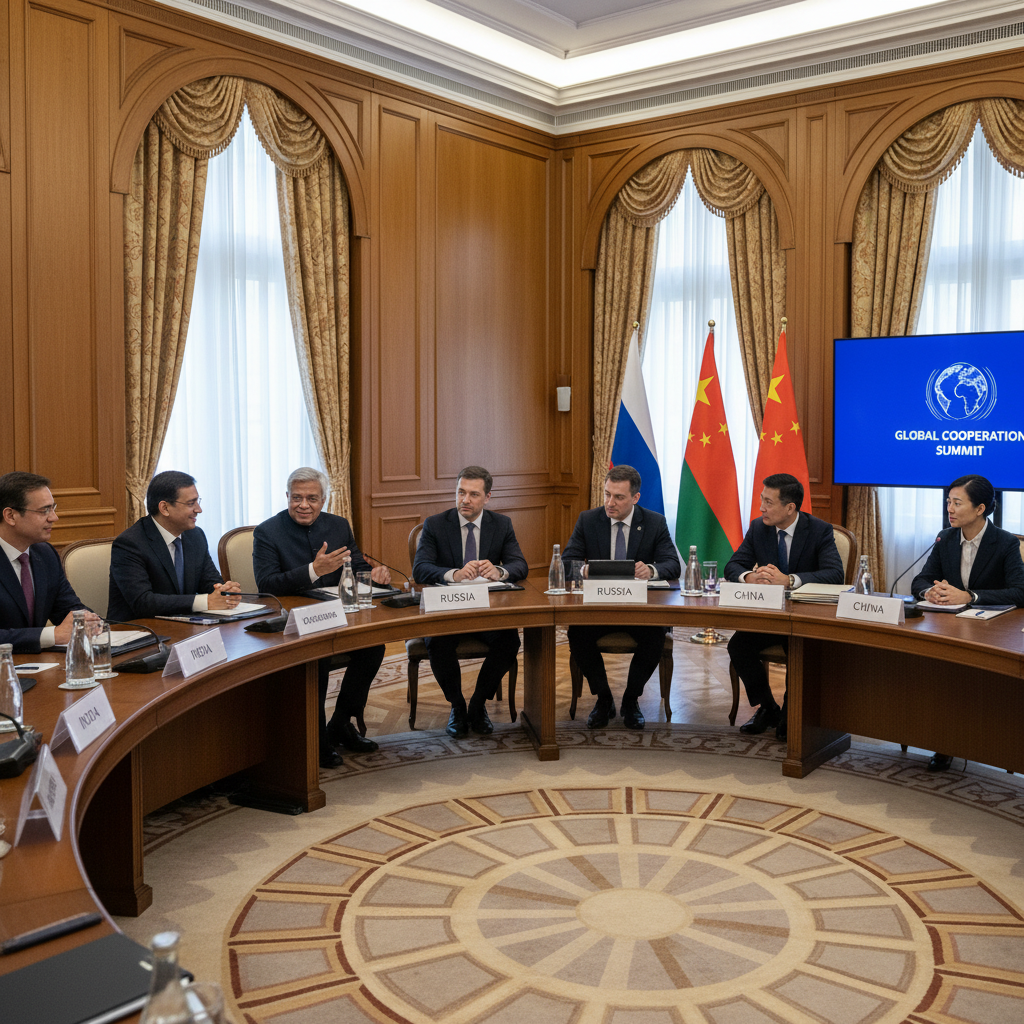
India’s national security adviser visited Moscow last month, and Foreign Minister Subrahmanyam Jaishankar held high-level talks in the Russian capital last week. Chinese Foreign Minister Wang Yi has just wrapped up his own visit to New Delhi. Prime Minister Narendra Modi is set to visit China for the first time in more than seven years, and Russian President Vladimir Putin is expected to host him in Moscow before the end of the year. The pivot to the east is more than a diplomatic formality, experts say.
Indians also appear fed up with what they see as Washington’s attempts to infringe on its sovereign right to make its own foreign policy decisions. “They’re signaling very clearly that they view that as interference in India’s foreign policy, and they are not going to put up with it,” Feigenbaum added.
Indian state-run refiners had earlier said they might reduce or even halt oil purchases from Russia, but they soon had second thoughts, lured by six- to seven-percent discounts on the back of a tariff waiver granted to India. That decision has paid dividends, and state-run Indian Oil Corp. in May imported more crude from Russia than from Saudi Arabia for the first time since February 2022. The math on oil is simple: a year ago, Russia accounted for 0.2 percent of India’s crude imports, but as of last month, it provided 35 percent.
Russia has given India every reason to double down on the arrangement. Deputy Prime Minister Denis Manturov said last week that Moscow “will continue to ship crude, oil products, thermal and coking coal to India.” There is also “potential for the export of Russian LNG to India.”
Causation and Correlation
Michael Kugelman, a Washington-based South Asia analyst, said that Trump’s tariffs are not the only factor that’s forced New Delhi to recalibrate its relationship with Washington.
“We’ve seen indications for almost a year of India wanting to ease tensions with China and strengthen relations, mainly for economic reasons. But the Trump administration’s policies have made India want to move even more quickly,” Kugelman told The National Interest.
The former ambassador to Turkey also noted that some of India’s recent moves are part of a larger diplomatic dance. But in other areas, “India is going to double down on some aspects of its economic and defense relationship with Russia — and those parts are not performative,” Feigenbaum said.
India’s decision to pivot to Moscow has been facilitated by New Delhi’s decision to decrease its military reliance on Russia over the last decade or so, buying an array of equipment from the U.S., France, and Israel, among other countries. But as India’s defense cooperation with Russia hit the brakes, its energy trade with Moscow has hit the gas. Kugelman said that’s “the culmination of a process of India beginning to view that the U.S. can’t be trusted, whereas Russia can — because Russia is always going to be there for India no matter what.”
Modi is also using this opportunity to burnish his credentials at home as a strongman who puts the nation’s sovereignty first. “Modi and other Indian leaders have emphasized their willingness to protect Indian economic interests, including the livelihoods of Indian farmers, small businesses, and young workers,” Kugelman said. “This message is resonating domestically — and for good reason.” The government had already made some concessions to the U.S., including tariff cuts and the return of migrant labor. “Because of those concessions, India needs to be careful about signaling further willingness to bend. This is one reason there was no trade deal — Modi put his foot down,” Kugelman added.
The frustration on the U.S. side is audible. In an op-ed in the Financial Times, Peter Navarro, a former White House trade adviser, accused India of “stealing American prosperity in plain view” with its Russian oil purchases. Navarro, an opponent of the trade deal with India, deemed the oil purchases “opportunistic and short-sighted” and “deeply corrosive.” His solution is simple: tariffs to punish India where it matters, in U.S. markets, “even as it seeks to cut off the financial lifeline it has extended to Russia’s war effort.”
Bumpy Road
The relationship’s downward spiral is a departure from earlier diplomatic breakthroughs in the India-U.S. partnership. Recall that in 2008, the U.S. and India signed a civil nuclear agreement that provided India with access to American fuel and technology despite its refusal to sign the Non-Proliferation Treaty. At the time, New Delhi and Washington managed to compartmentalize their disagreements to prevent them from seeping into other areas of cooperation.