- calendar_today August 25, 2025
CNN spoke to three European officials on Wednesday that Germany, France, and the United Kingdom are getting ready to initiate the process for the return of UN sanctions against Iran. Known as the “snapback” mechanism, the 2015 Iran nuclear deal allowed the three countries to restore international sanctions against Tehran in the case of a material breach of the agreement. The process could be initiated as soon as Thursday.
A European source said the 30-day process to fully reinstate the sanctions means there is “a limited window for diplomacy” and European leaders hope Tehran will use the time to reengage in serious negotiations, open its facilities to international inspectors, and take steps to come back into compliance with its nuclear obligations. Iran, on the other hand, has threatened serious retaliation if those sanctions return and the prospect of more instability is a threat to a region already in turmoil due to the recent conflict.
Snapback Mechanism Close to Expiration Date
Member countries of the 2015 Joint Comprehensive Plan of Action (JCPOA) have the authority to trigger the snapback mechanism, re-imposing UN sanctions on Iran. If a country is found to be in violation of the agreement, the authority to trigger the snapback provision will expire in October.
Since then, the Islamic Republic has expanded its nuclear program beyond JCPOA limits and the U.S. left the deal under former President Donald Trump. Tehran has long maintained that its nuclear program is for peaceful purposes only, but inspectors and experts warn it is now at or nearing the threshold of capabilities for a weapon.
“In the current situation, returning to the original JCPOA will be almost impossible,” Rafael Grossi, head of the International Atomic Energy Agency (IAEA), told reporters Wednesday.
Speaking Wednesday at the U.S. State Department alongside his European counterparts, U.S. Secretary of State Marco Rubio said the snapback mechanism “is a very powerful piece of leverage on the Iranian regime.”
IAEA inspectors returned to Iran this week, even as the Iranian parliament passed legislation to stop cooperation with the international agency. Grossi confirmed IAEA inspectors were at the Bushehr nuclear power plant Wednesday.
“We are in Bushehr, we are working. Today we are inspecting Bushehr,” Grossi said at a news briefing in Washington. “We are continuing the conversation so that we can go to all the places, including the facilities that have been attacked.”
Grossi’s IAEA safeguards are provided under the Nuclear Non-Proliferation Treaty (NPT) of which Iran is a signatory. Tehran reportedly has the option to pull out of the NPT if the snapback sanctions mechanism is triggered. Pulling out of the NPT and removing IAEA inspectors is one of several options Iranian Supreme Leader Ayatollah Ali Khamenei reportedly gave his team, if snapback sanctions are approved.
Iran’s foreign minister Abbas Araghchi said Wednesday the IAEA was allowed to monitor the fuel replacement at Bushehr under a decision by Iran’s Supreme National Security Council. He denied that Tehran reached any agreement with the IAEA for “new cooperation.”
Fallout of Recent Conflict Continues
Relations between the West and Iran have sharply deteriorated since Israel attacked Iran’s nuclear facilities in June, starting a 12-day conflict. Iran retaliated by launching missile attacks on Israeli cities. The U.S. eventually got involved in the final days, launching strikes on three Iranian sites.
The IAEA said in July it was removing inspectors from Iranian nuclear sites because of the wartime situation that made it impossible to monitor. Satellite images published in August showed debris and bullet holes at the entrance of Iran’s Isfahan Nuclear Technology Research Center.
In response, Iran accused the IAEA of providing Israel with a pretext for its attack by publicizing Iran’s non-compliance with the international agency’s safeguards rule.
Iran at Odds With Itself Over IAEA Return
Kamran Ghazanfari, a member of Iran’s parliament, published a letter to his country’s Atomic Energy Organization on Wednesday in which he decried the decision to allow IAEA inspectors back into certain facilities. He specifically condemned comments by Parliament Speaker Mohammad Bagher Ghalibaf supporting the inspectors’ limited return. Ghazanfari called the comments an “explicit violation” of the law passed by Iran’s parliament that suspended cooperation with the IAEA.
Iran’s parliament voted to pass legislation that suspended cooperation with the IAEA after the June conflict broke out. At the time, it was framed as a measure to protect Iranian sovereignty against foreign aggression and an attempt to stop what Iran’s Supreme Leader Ayatollah Ali Khamenei said were biased IAEA reports on Iranian non-compliance.
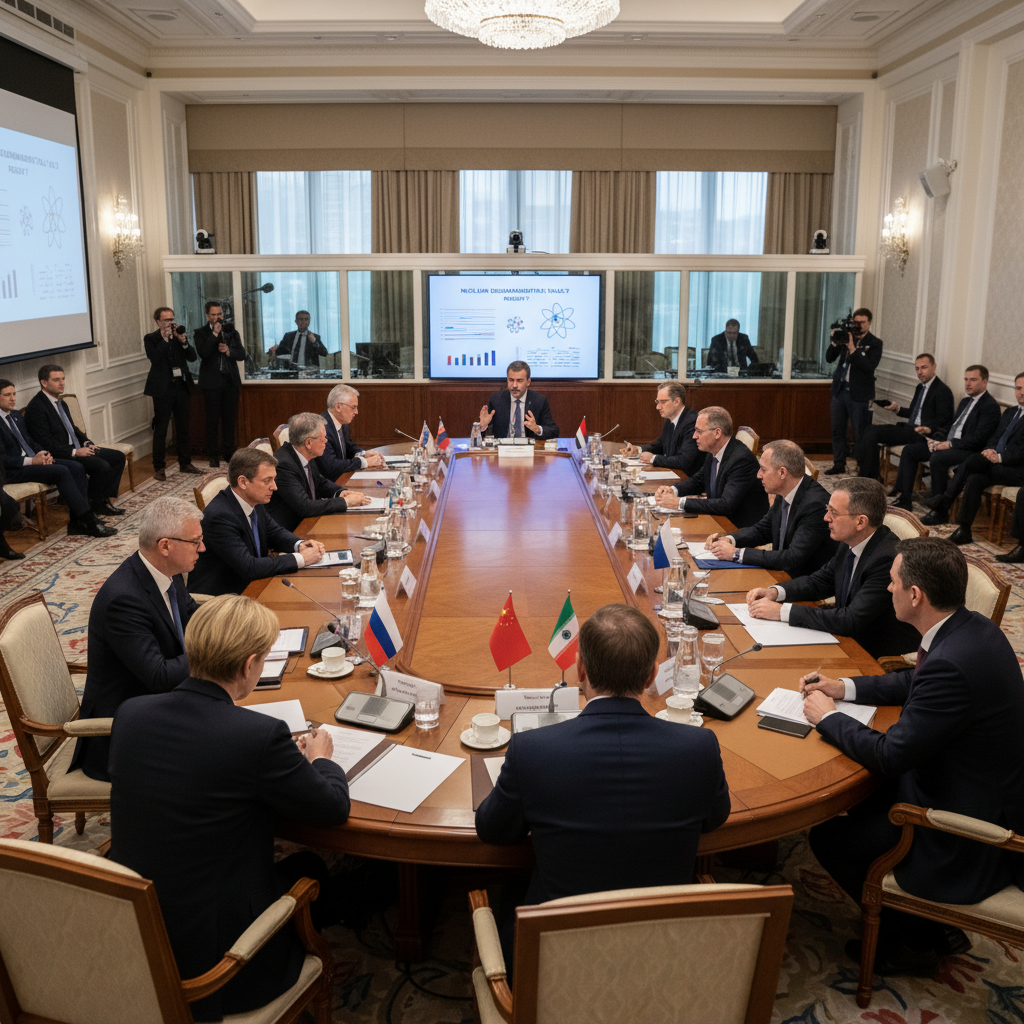
European negotiators met with Iranian officials in Geneva on Tuesday to try to head off sanctions. There was little indication of any progress.
The U.S. and Iran were in talks in the months leading up to the conflict and U.S. envoy Steve Witkoff said he was engaging in diplomatic efforts to reach a new nuclear deal with Iran. Those talks, too, went off the rails with the start of the conflict.
Grossi said it is possible the coming month may see de-escalation. “Don’t forget that there is still time, even if there is the triggering thing, there is a month, and many things could happen,” Grossi told reporters.